
Fractional CTO
myHappymind
A review of security, hosting and operational controls to establish which improvements should take priority as the wellbeing platform scaled and prepared for investor scrutiny.
Technical Due Diligence
View Case Study
An independent assessment before you invest, acquire or plan integration.
Understand which technology risks could affect the investment case, ownership handover and cost of change. FoundationState provides technical due diligence services for UK investors and acquirers, reviewing the agreed evidence across business systems, software platforms, security posture and engineering capability. The assessment sets out findings, limitations and prioritised actions.
Free initial 1–2 hour discovery session.
Finding F02 · E01 / E03
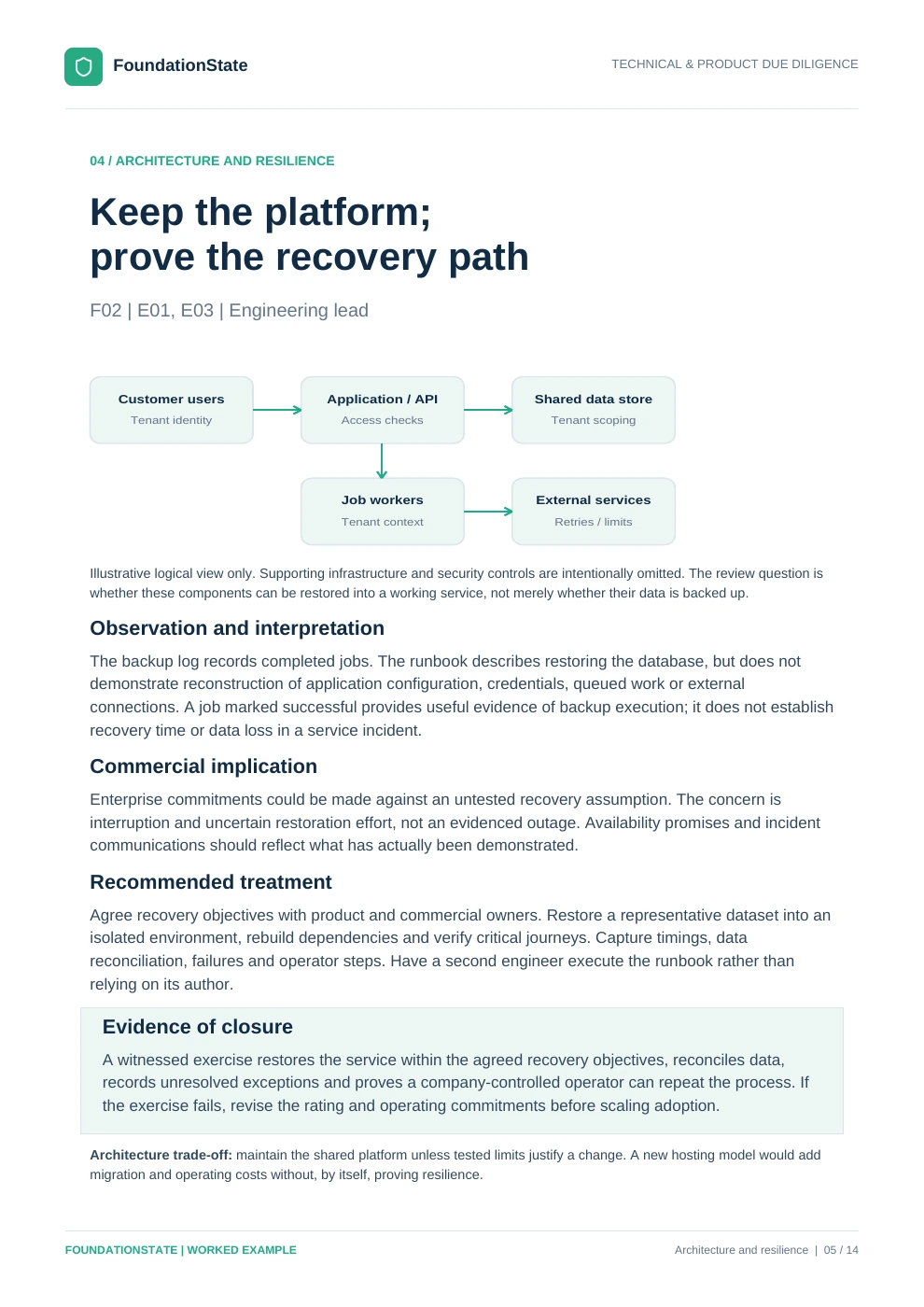
A database restore alone does not prove that the service can return to operation.
Inspect the platform, access and recovery evidence behind the investment case.
See what the work produces
Explore one excerpt from our public 14-page worked report: how evidence connects to a business decision.
The backup log records completed jobs. The runbook covers the database; service reconstruction has not been demonstrated.
Public and ungated. The worked example illustrates the reporting approach; it is not a client assessment.
How to read the reportWhat could affect the investment case?
Examine whether the technology can support the business plan, and which architecture, security or delivery assumptions need further evidence.
What needs control on Day 1?
Identify who controls business-critical systems, supplier accounts, administrative access and recovery arrangements before ownership changes.
What needs action after close?
Separate immediate concerns from longer-term remediation, with the evidence, dependencies and ownership needed to plan the next steps.
Small, Medium and Large describe review breadth, from a focused question to deeper engineering evidence. Combine services where useful; discovery confirms the bespoke scope.
Focused platform and security snapshot
The Small Technical Due Diligence engagement provides a rapid, structured assessment of the target’s core technology estate, operational hygiene, and public-facing risk exposure.
It is designed for lower-complexity transactions where the priority is Day-1 visibility on avoidable technical, security, and ownership risks rather than a deep architecture rewrite assessment.
Fast-moving reviews usually complete once tool access, admin ownership, and basic security documentation are available.
Seed to Series A investments, smaller acquisitions, or initial technology assessments
Custom scoped
Quoted based on the number of systems, users, and business entities included in scope.
Broader platform, operations, and vendor risk evaluation
The Medium engagement expands beyond Day-1 hygiene to test how resilient the platform, operating model, and delivery practices really are under growth or ownership change.
It is intended for businesses with a more established product and technical estate, where architecture, vendor concentration, and operational maturity can materially affect value creation.
Timing depends on system access, stakeholder interviews, and the breadth of infrastructure and operating workflows under review.
Series B+ investments, growth equity, and mid-market acquisitions
Custom scoped
Quoted based on estate complexity, number of environments, and diligence depth required.
Enterprise-grade technical risk and value creation assessment
The Large engagement is built for complex technology estates where platform depth, operating maturity, and investment prioritisation all influence deal value.
It combines technical risk assessment with commercial framing, integration readiness, and investment planning so buyers can understand both the current state and the likely cost to improve it.
Delivery timing depends on the number of products, environments, teams, and integration or separation questions included in the review.
Large PE transactions, strategic acquisitions, and complex multi-product platforms
Custom scoped
Quoted based on multi-product complexity, organisational breadth, and the value-creation workstreams required.
Many transactions benefit from combining Technical Due Diligence with Product Due Diligence.
Technical Due Diligence evaluates the technology platform, while Product Due Diligence evaluates the product organisation and roadmap execution capability.
Together, these assessments provide a complete view of technology-driven businesses.
Platform, infrastructure, security, and engineering risk.
Product strategy, roadmap feasibility, delivery execution, and growth-readiness.
Technical Due Diligence provides investors with:
A clear view of platform, infrastructure, and security risk.
Understanding of Day-1 ownership and operational transition issues.
Insight into engineering maturity and delivery resilience.
Identification of structural architecture, dependency, and scalability constraints.
Prioritised remediation actions for post-close execution.
Published engagements showing how FoundationState has approached technical risk, platform resilience, ownership and practical recommendations. Each case states the work and outcomes in its own context.
A review of security, hosting and operational controls to establish which improvements should take priority as the wellbeing platform scaled and prepared for investor scrutiny.

Technical due diligence covering security posture, marketing-site resilience, email security, tooling decisions, and the operational improvements needed to support growth.

Technical due diligence spanning server migrations, security hardening, integrations, backups and monitoring, plus the website and SEO improvements needed to support a more resilient operating environment.
How to begin
Free 1–2 hour conversation about your business, pain points and decisions ahead.
Agree the evidence, scope, deliverables, timing and quote before starting.
Connect interviews and evidence across the product and technology questions that matter.
Discuss findings, ownership and practical priorities. Agree further advice where useful.
Who you work with
Work directly with Ryan Musselwhite, FoundationState’s Founder & Lead Consultant. His published experience spans transaction support, technology risk reviews and product and technology leadership.
Meet Ryan and explore his experienceBefore commissioning a review
Contact FoundationState today to discuss your due diligence needs and receive an independent assessment.